Murray Bowen (1913-1990)
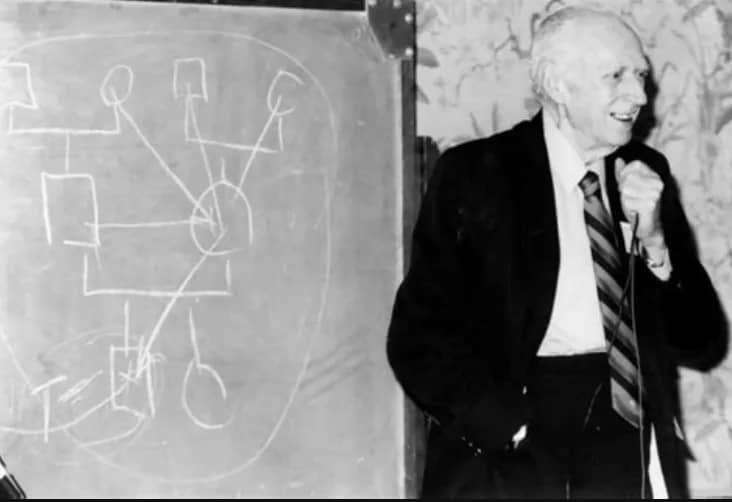
Pioneer of family life and dynamics
Murray Bowen was a psychiatrist who revolutionized the way we understand families. After serving in WWII and training in psychoanalysis, he shifted focus from individual treatment to family relationships. Bowen introduced Family Systems Theory, which views families as emotional units shaped by patterns passed across generations. His key concepts—like Differentiation of Self, Triangulation, and Emotional Cut-Off—remain central in therapy today.
Founder of the Bowen Center in Washington D.C., Bowen emphasized emotional honesty, self-awareness, and the power of relationships. His legacy lives on in psychology, education, and even leadership—wherever human connection matters.
Early Life and Education
Murray Bowen was born on January 31, 1913, in Waverly, Tennessee, to Jesse C. Bowen and Mary Baldwin Bowen. Raised in a close-knit family, Bowen grew up in a rural environment that emphasized strong family ties and a connection to the community. This early experience of family dynamics likely influenced his later interest in relationships and interpersonal systems where he became a pioneer of family life and dynamics.
Bowen initially pursued a career in medicine. He earned his Bachelor of Science degree from the University of Tennessee in 1934 and his medical degree from the same institution in 1937. His early ambition was to specialize in surgery, but his interests gradually shifted toward psychiatry, a field that allowed him to explore the psychological and relational aspects of human behavior.
World War II and Early Psychiatric Career
During World War II, Bowen served as a medical officer in the U.S. Army. His work with soldiers dealing with trauma and psychological stress deepened his interest in psychiatry. After the war, he trained in psychiatry at the Menninger Foundation in Topeka, Kansas, a renowned center for psychoanalytic study. This experience provided Bowen with a strong grounding in Freudian psychoanalysis, which was the dominant model of psychiatry at the time.
However, Bowen began to question the traditional focus on individual psychology. He observed that understanding patients required considering their relationships and broader familial contexts. This realization set him on the path to developing a revolutionary approach to mental health.
Development of Family Systems Theory
In 1954, Bowen joined the National Institute of Mental Health (NIMH), where he conducted pioneering research into family dynamics. By observing families of patients diagnosed with schizophrenia, Bowen identified patterns of interaction that seemed to perpetuate emotional dysfunction across generations. He became convinced that psychological problems could not be fully understood in isolation from family relationships.
In 1959, Bowen accepted a position at Georgetown University, where he refined and formalized his ideas into what became known as family systems theory. This theory proposed that families operate as emotional units, where the behavior of each member influences and is influenced by the others. Bowen introduced several key concepts, including:
Nuclear Family Emotional System:
The Nuclear Family Emotional System describes the emotional functioning within the core family unit. Bowen identified recurring patterns such as marital conflict, dysfunction in one spouse, or problems in one or more children. These patterns emerge as families attempt to manage stress and anxiety, often influencing the mental and emotional well-being of all members.
Differentiation of Self
Differentiation of Self refers to an individual’s ability to maintain their sense of identity while remaining emotionally connected to others. Highly differentiated individuals can balance independence and closeness in relationships, while those with low differentiation are more likely to become enmeshed or emotionally reactive in their interactions.
Triangulation
Triangulaton occurs when two family members experiencing tension draw in a third person or issue to stabilize their relationship. While triangles reduce immediate anxiety, they often perpetuate underlying conflict. Through projection, parents may transfer their unresolved issues onto a child, which can influence the child’s development and emotional functioning.
Family Projection Process
Closely related to Nuclear Family Emotional System and Triangulation is the Family Projection Process, which explains how parents unconsciously pass their emotional concerns, anxieties, and expectations onto their children. This dynamic can profoundly affect a child’s development, often leading to similar emotional challenges in the next generation. The intensity of this process varies from family to family but typically plays a significant role in shaping the emotional climate of the household.
Emotional Cut-Off
Emotional Cut-Off occurs when individuals attempt to manage unresolved emotional issues with their family by reducing or severing emotional contact. While this may temporarily relieve anxiety, it often leads to unresolved tensions being carried into new relationships or resurfacing in future family dynamics. Emotional cutoff is both a symptom and a perpetuator of family dysfunction.
Sibling Position
Bowen’s theory also incorporates Sibling Position, which draws on the idea that birth order influences personality and behavior. He argued that individuals take on roles within their families based on their sibling position, affecting how they function within both familial and broader relational systems. For example, firstborn children might be more inclined toward leadership roles, while later-born children may adopt more adaptive or rebellious behaviors.
Societal Emotional Process
Finally, Bowen extended his theory beyond families with the concept of the Societal Emotional Process, which applies the principles of emotional systems to society as a whole. He suggested that societal anxiety—caused by economic instability, political unrest, or cultural shifts—can mirror the emotional processes of families, leading to periods of progress or regression on a collective level.
Bowen emphasized the role of anxiety in family systems, showing how emotional tension could disrupt relationships and lead to psychological symptoms.
Research and Clinical Practice
Bowen’s methods were groundbreaking in their emphasis on observing entire families rather than focusing solely on individuals. He used videotaped sessions to study family interactions and encouraged therapists to include family members in the treatment process. His work represented a shift from the individualistic focus of psychoanalysis to a relational perspective that examined systems of interaction.
The publication of his seminal work, Family Therapy in Clinical Practice (1978), brought his ideas to a wider audience and established family systems theory as a cornerstone of modern psychotherapy.
The Bowen Center for the Study of the Family
In 1975, Bowen founded the Georgetown Family Center, now known as the Bowen Center for the Study of the Family. The center became a hub for research, training, and clinical practice based on family systems theory. Bowen’s mentorship of countless therapists and researchers helped to spread his ideas across disciplines, influencing fields such as social work, counseling, and organizational leadership.
Philosophical Approach and Legacy
Bowen saw families as part of larger evolutionary and biological systems, emphasizing the interconnectedness of human behavior. He believed that understanding the family as a unit provided insights into broader societal patterns and even human evolution. His systemic approach encouraged therapists to move beyond blame and focus on understanding relational dynamics.
Bowen was also a proponent of therapists engaging in their own self-differentiation—an idea that required them to explore their family histories and relationships to better understand their own emotional functioning.
Personal Life and Later Years
Bowen married Ann Dillon, with whom he had five children. Despite the intense focus he placed on his professional work, Bowen maintained a commitment to family life, which he considered central to his understanding of human behavior.
He continued teaching, researching, and practicing until his death on October 9, 1990, in Washington, D.C. Even in his later years, Bowen remained dedicated to exploring how families could achieve healthier, more adaptive functioning.
Enduring Influence
Murray Bowen’s family systems theory remains a foundational model in psychotherapy and counseling. His holistic approach to understanding human relationships has influenced not only mental health professionals but also educators, organizational leaders, and policymakers. By shifting the focus from individuals to relational systems, Bowen provided a lens through which we can better understand and navigate the complexities of human connection.
Break the Pattern
Our Break the Pattern Focus Challenge is based on Murray Bowen's Family Systems Theory